“A Clean Well-Lighted Place (And Countless Crates in the External Storage Space)”
MICHAEL ASHER / NINA BEIER AND MARIE LUND / BLESS / MATHEW CERLETTY / MATIAS FALDBAKKEN / KRISTJÁN GUÐMUNDSSON / ANE METTE HOL / AARON FLINT JAMISON / MICHAELA MEISE / CHADWICK RANTANEN / JOSH SMITH / LAWRENCE WEINER / OLAV WESTPHALEN
"A CLEAN WELL-LIGHTED PLACE (AND COUNTLESS CRATES IN THE EXTERNAL STORAGE SPACE)"
12.03.2026-18.04.2026 / PREVIEW: THURSDAY 12.03.2026 / 18:00-20:00
-----
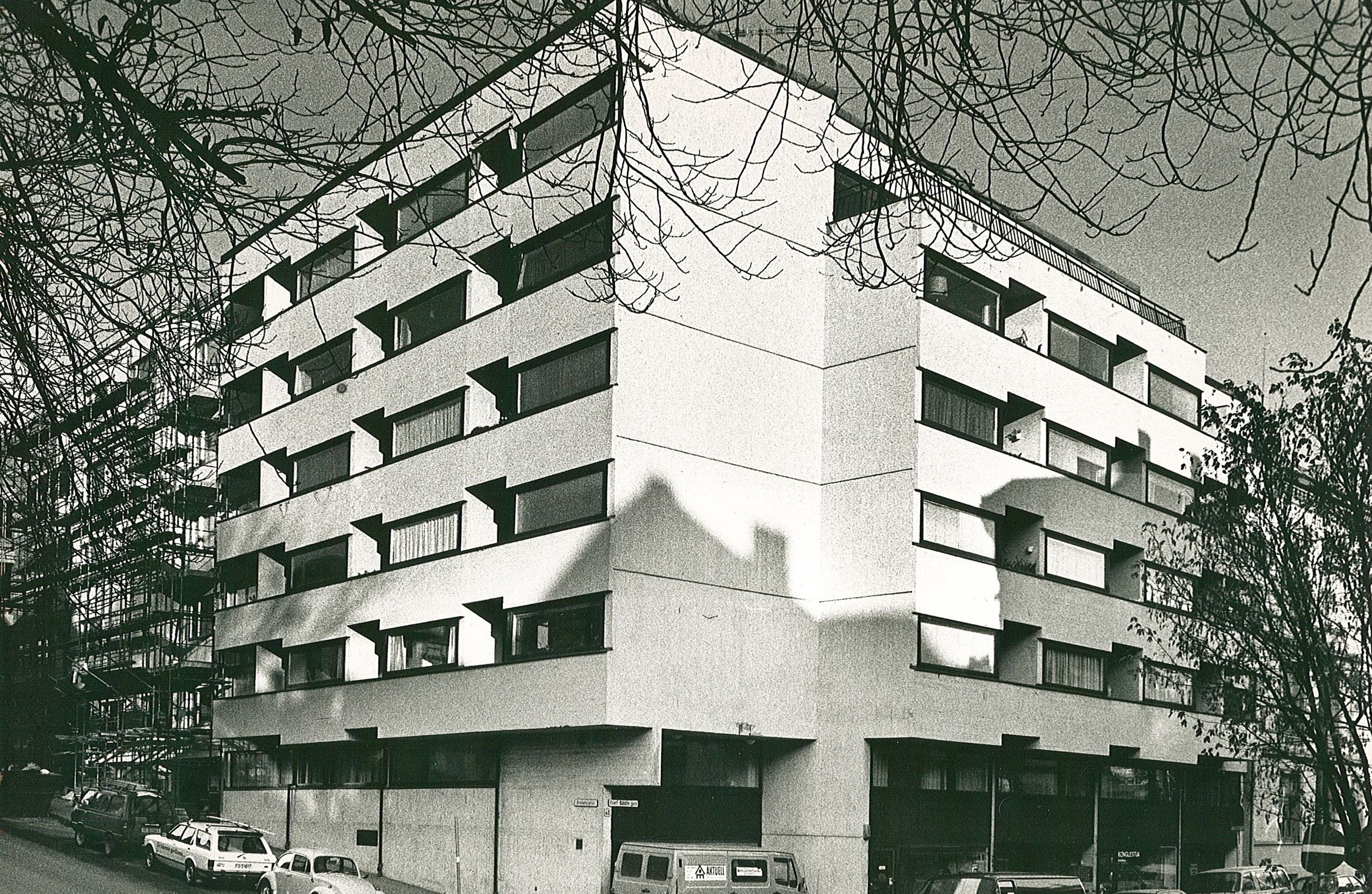
The exhibition “A Clean Well-Lighted Place (And Countless Crates in the External Storage Space)”, takes STANDARD (OSLO)’s relocation to a new gallery space as its point of departure. After 20 years of business at two previous addresses, the gallery will for the next ten years be situated on the ground floor of Eilert Sundts gate 40 - a concrete apartment building designed by the Norwegian architect Bjarne Tjønn (1925-1996) and completed in 1963 - in the Uranienborg district of Oslo.
As with any other move - whether moving home or workplace - it offers a moment to think through what has been and what can be. When such a move comes after 20 years of operation, it inevitably also offers a confrontation of who you are based on what you own. Weeks and months were spent with the overwhelming task of sorting through the gallery’s bookshelves, archives, workshops and storage spaces - attempting to sift through, slim down and carefully select what was required for a future version of the gallery. However, what was intended as a considerate act of catharsis, rather resulted in comical confusion as to what objects you own because you need them, think you need them, feel attached to them, or simply - for whatever reason - fail to get rid of them. Hence the moving trucks left with a little more than just a little.
It could not be in starker contrast to the portrait of a private gallery that is offered by Michael Asher in his work “Claire S. Copley Gallery, Los Angeles, California, USA, September 21–October 12, 1974”. It is one of several similar architectural interventions that Asher did during this decade, which had him removing the partition wall that separated the exhibition space from the office space. As the exhibition space was left entirely empty, all attention was drawn to the day-to-day activities of the gallery. It is a historically significant work to what we consider the category of “institutional critique”, but revisiting the work in the context of our relocation it offered a striking difference in terms of gallery setup. When looking at the photo documentation of Michael Asher’s installation, one is struck by the sheer modesty of the entire operation of Claire Copley Gallery. Most likely, it was not so different from other galleries back in Los Angeles in 1974 or any gallery of any city of that time; reduced to a table with three chairs, a flat file, a bookshelf, together with a few paintings leaning up against the back wall. A single van and a few hours of work, is all that would be needed to entirely empty the gallery.
There is a photogenic clarity to these iconic installation views, which is as much the result of Asher’s photographic composition as it is the result of a radical reduction of the number of objects that would surround and support a gallery today. Where are the computers, the cables, the chargers, the gadgets, the hard drives, the tools, the instruction manuals, the spare parts, the unsold catalogues, the storage units, the empty crates, the fair furniture, the vases for flowers gifted on opening evenings? Over the years - with previous moves and iterations of the gallery - these sort of objects, as well as gifts from artists, clients and colleagues, leftovers from previous tenants or lost items from openings that were never reclaimed, have all come into the gallery’s possession. Central to the exhibition is a shelving unit that gathers a number of these items, which is offering an archive of seemingly insignificant and irrelevant objects. It suggests a support structure that is crucial to the gallery, but mostly invisible to its visitors.
Adding to this shelving unit is a number of artworks that equally draw attention to such a support structure. These are works that refer to simple acts, such as packing, preparing, measuring, storing, shipping, archiving and announcing. Inevitably, “A Clean Well-Lighted Place (And Countless Crates in the External Storage Space)” takes an interest in the gallery space being everything but an exhibition space. As much as it is a space of artworks - a space of creation and culture, or even a space of transcendence - it is also a space of routines, of technical requirements and of prosaic processes. “A Clean Well-Lighted Place (And Countless Crates in the External Storage Space)” is thus an exhibition exploring the foundational building blocks onto which something else can be built.
-----
For further information please visit our webpage: www.standardoslo.no or contact Eivind Furnesvik at eivind@standardoslo.no or +47 917 07 429 / +47 22 60 13 10. STANDARD (OSLO) is open Wednesday-Friday: 12.00-17.00/ Saturday: 12.00-16.00. Sunday and Monday: Closed. Tuesday: Open by appointment.
-----
Photography: Gunnarsjaa, Arne
License: Attrbution-ShareAlike (CC BY-SA), Digitalt museum, Oslo Museum
-----